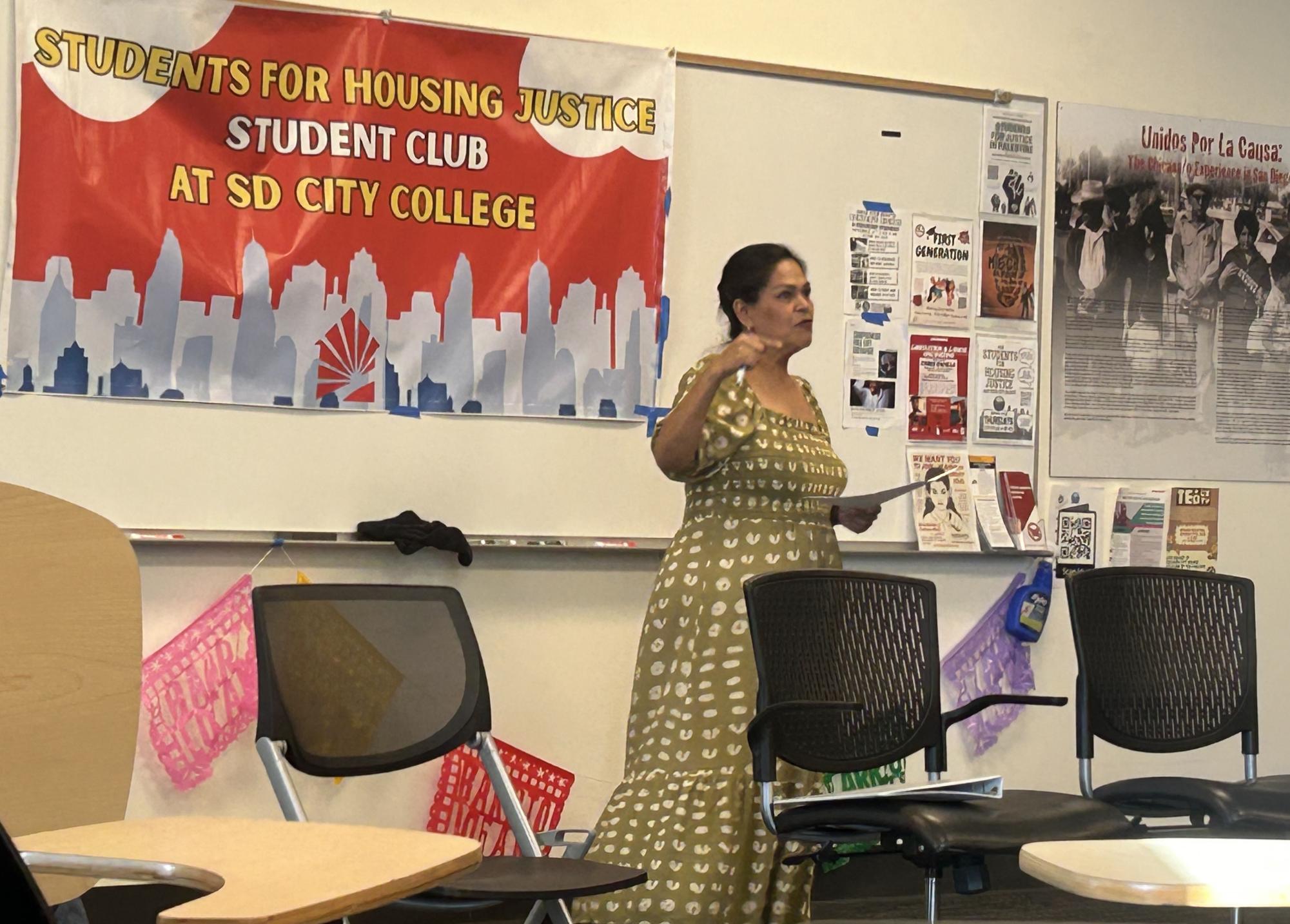
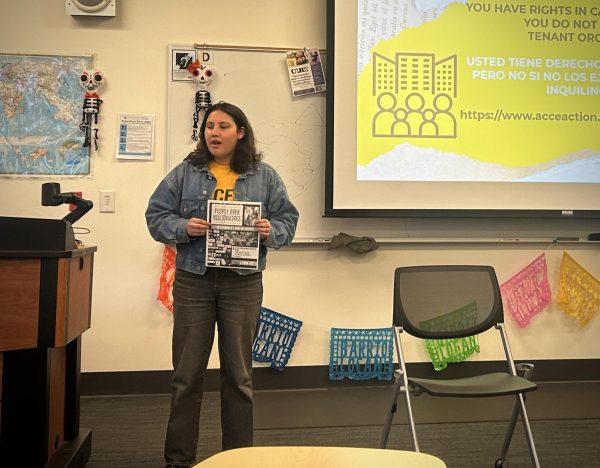
Students for Housing Justice at San Diego City College held a renters’ rights workshop focused on helping attendees understand tenant rights laws in California and San Diego.
The seminar, held on Dec. 4 in MS-462, included a presentation by Ana Ramos, an organizer at Alliance of Californians for Community Empowerment Action, who addressed rent caps, local and statewide tenant protections, and the eviction process.
ACCE Action is a statewide grassroots community organization with more than 15,000 members that dedicates itself to “empowering the community to advocate for themselves, and we primarily fight for racial, social and economic justice in working class communities,” according to Ramos.
Why SHJ hosted this workshop: San Diego residents are experiencing a housing crisis with renters needing to earn $47.67 per hour to afford the average monthly asking rent of $2,479, according to the California Housing Partnership report.
San Diego Community College District students are disproportionately affected by this housing affordability issue. According to 2025 district data, 59% of students said they were struggling with housing insecurity and 23% identified as homeless.
“We need to address this crisis because it’s impacting our students in such a devastating way,” said Justin Akers, the club advisor for SHJ, in a public comment. “As a faculty member, a professor of Chicano Studies, I am dealing with crises daily amongst my students.”
SJH is dedicated to assisting homeless students and the memory of Izzy Soto, a City student who was homeless and was found dead inside the van he was living in earlier this year.
“We’re trying to raise awareness, we’re trying to organize and to effectively try to create campaigns that can work with, you know, other institutions on campus that are also trying to support students around housing,” Akers said in the same public comment. “But we’re also calling on the district, and we’re calling on the administration to do more.”
The group is currently pushing for a safe overnight parking site on campus as well as access to cleaning stations for students.
This workshop is a step forward in assisting City students struggling with housing insecurity and offers support in the face of uncertainty.
Tenant Protection Act of 2019: Also known as AB 1482, this act limits the annual rent increase to no more than 5%, plus a change in the yearly cost of living or 10%, whichever is lower. As of July 2025, this cap is 8.8% in San Diego, according to Ramos.
Landlords are also required to have a “just cause” in order to terminate tenancy. This allows for two basic types of eviction: at-fault and no-fault.
- At-fault evictions take place when the landlord is given legal reasons to evict as a result of actions a tenant takes
- No faults occur when a tenant has done nothing wrong, but the landlord has legal reasons to evict
After a year of tenancy, landlords cannot evict tenants without a “just cause.” They have to provide a reason — the landlord wants to move into the property. In this case, or in other no-fault eviction cases, the tenant is entitled to one month’s rent as a relocation assistance payment.
Price gouging protections: California passed Penal Code 396, a temporary measure that bars landlords from raising rents 10% more than what they were charging before a state of emergency was declared. This applies when a state of emergency is passed by the president, governor or local government.
In January 2024, hundreds of homes were damaged, and many people were displaced due to San Diego’s historic flooding. Local states of emergency were proclaimed by the City of San Diego. The Southcrest neighborhood was one of the hardest hit by these major floods.
“Knowing that people needed to find a place,” Ramos said. “They took advantage of people’s situation.”
Protections for immigrants: Ramos reminded attendees that all of these protections apply to everyone, regardless of immigration status.
“They (landlords) cannot legally require a tenant to have a social security number, or like a SD (San Diego) ID, to consider them for tenancy,” Ramos said.
There are special protections in place for immigrants under AB 291, which prohibits landlords’ attorneys from using a tenant’s legal status in court against them.
“In the current state of the administration, we know that particularly immigrants are very more vulnerable to be evicted,” Ramos said.
Where to learn more: Students for Housing Justice hold meetings every Thursday from 2:10-3:10 p.m. in MS-462. They offer additional information at these meetings, including:
- How to organize for rent control
- How to organize a tenant association in your complex
- How to fight and prevent eviction
SHJ will be hosting another workshop on how to respond to ICE on campus at their next meeting on Dec. 11 at 2 p.m.
You can sign up for the club using this form.
This story was edited by Briana Bush and David J. Bohnet.