For Vanessa Gambino, a cybersecurity major, one class provided her with a community and the space to be herself.
It was called Introduction to Disability Studies.
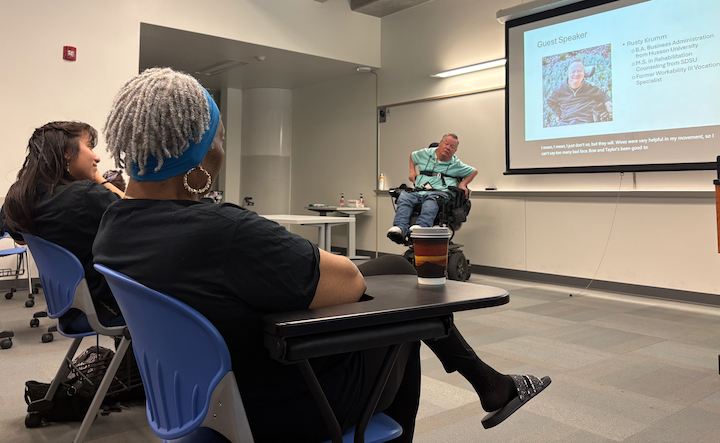
The class of about 20 students is taught by Tayler Nichols, a Disability Support Program and Services counselor at San Diego City College.
“For me, my disability doesn’t define me,” said Gambino, who uses a walker. “But my community can change (me) and be a part of me, my identity. I am a part of this.”
The Introduction to Disability Studies class provides a space for students to look at and deconstruct their beliefs about disability, allowing for the opportunity to grow and gain empathy.
The class covers topics such as models of disability, the history of disability and disability rights.
Among the most important lessons students learned was the social model of disability, which focuses on the societal barriers constructed to prevent inclusion rather than regarding the disability as the problem.
“One of the things you learn in class is anybody can be disabled at any time of their life,” said Muz Hansia, also a cybersecurity major. “(The disabled community) is like a club anyone could be vaulted (into at) any time. Anybody can make fun of somebody with (a) disability, and then two days later, they’re a part of that group.”
Hansia said that if everyone had this awareness, many issues around disability would be solved.
Disability is not a rare or new phenomenon, as more than 25% of adults in the United States have a disability, according to the CDC.
That includes visible disabilities, such as Down syndrome, amputations, and cerebral palsy, or invisible disabilities, such as deafness, postural orthostatic tachycardia syndrome, and bipolar disorder.
Studies show disabled people face a range of adversities and discrimination.
Poverty and homelessness disproportionately affect the disabled community, according to the California Department of Housing and Community Development.
In 2024, the employment rate for working-age disabled individuals was 38%, almost half of the comparable non-disabled population, according to the Employment and Training Administration.
Disability-based employment discrimination consistently ranked among the highest for types of charges filed from the year 2020-24, according to the Equal Employment Opportunity Commission.
These traumas were echoed by students in the class, who shared their own experiences of discrimination throughout the term.
“(Non-disabled people) don’t understand a lot of the time,” Hansia said. “And they tend to get very defensive. They see it as a form of threat or something below, or they tend to think of us, a lot of the time, as a nuisance.”
Many students in the class were able to connect with that.
Bill Henderson, a student in the Geographic Information Systems program, said stigmas surrounding disability stifled his ability to connect with himself and accept help.
“I think for a long time, I didn’t want to be disabled. I don’t have a problem,” Henderson said. “But here I am at this age with these particular situations the past couple years, and I’m like, wait, I’ve got well more than one problem.
“I started adding all those up and going, all right, I’ll label myself disabled.”
Being in the class was a huge help for Henderson with understanding himself and navigating the challenges he has.
Other students shared how this class helped them create a community of people who may not share the same background but face similar difficulties from society.
“We come from different backgrounds,” Gambino said. “You stand in this part of the society, (and you) don’t understand each other. So if we want to create a community, we need to understand the person we don’t agree with … (and) we need to respect at some point.”
She advocated for letting kids learn early on about disability and how it could affect them sometime in the future, or even now.
Gambino said everyone would benefit from taking the class, and it should be mandatory.
“You can take a different direction,” Gambino said, reflecting on her journey. “Take action. You come (to this class) and not be a part of the problem, (but) be a part of (the) solution.”
This story was edited by Briana Bush and Angela Galan Martinez.