Skip to Content
Categories:

PRIMARY ‘26: Porter pledges to not take corporate donations for California gubernatorial campaign (with video)

Former congresswoman Katie Porter emphasizes grassroots focus with over 100,000 individual campaign contributors
Former congresswoman Katie Porter is running for governor of California. Source: Campaign website, Katie Porter for Governor

Sixth in a series of introductions of candidates for California governor running in the 2026 Primary. The top two vote-getters in the primary election – regardless of party preference – move on to the general election in November, according to the California Secretary of State.

California gubernatorial candidate and Democrat Katie Porter is a consumer protection attorney who began her political career in 2017, following the election of President Donald Trump. 

Porter was a key part of the Democratic Party’s national strategy to regain control of the United States House of Representatives in 2018.

She successfully flipped California’s 45th Congressional District, which covers Orange County, from red to blue, becoming the first Democrat to represent the area in 75 years

Porter was reelected in 2022 and represented the 47th Congressional District following the area’s redistricting, serving three total terms in Congress from 2019 until 2025.

During Porter’s time in Congress, she served the House Committee on Natural Resources and the Committee on Oversight and Reform. 

This work included serving as the chair of the Subcommittee on Oversight and Investigations, which targeted waste, fraud and abuse.

Previous to her political career, she worked as the independent monitor for California’s share of the National Mortgage Settlement. 

During this time, Porter fought Wall Street banks in the aftermath of the foreclosure crisis, where she made sure they answered for predatory lending practices by enforcing settlement agreements.

 “One of my favorite cases we worked on, somebody got a notice of foreclosure, the house was foreclosed on,” Porter said in an X post. “And the next day they got a letter forgiving their mortgage loan. We forced the bank to cut a check to that family for six figures and to make it right.”

As we near the 2026 California Primary, Porter has decided to continue to take a stance against big corporations and billionaires, running on making California more affordable. 

As a single mom of three kids, I know that everything feels ridiculously expensive right now,” Porter said on her campaign website. “I have seen how the purchasing power of families has gotten worse since the pandemic.”

In April, City Times published the 2026 edition of the City College Community Agenda, a survey that identified issues that students, faculty, staff and community members cared about. 
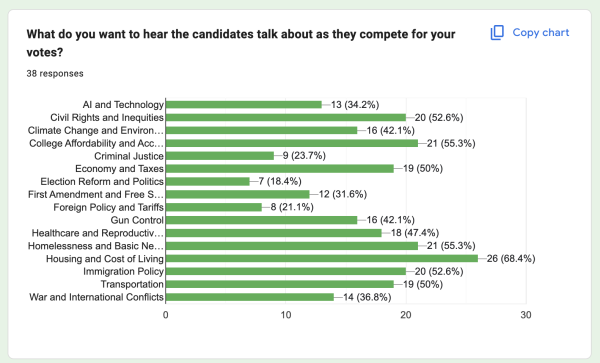
Results of the City College Community Agenda survey, as of Wednesday, April 29, 2026. Source: Google Forms


City Times Media is using the results to focus its election reporting, breaking down gubernatorial candidates’ statements shared through official sources and made during debates and forums.

Early survey results identified eight issues that matter most to the City College community.

Here is how Katie Porter stands on each.

College affordability and access

Porter believes that removing the financial barriers of college education is necessary for California’s economic future, and is proposing tuition-free college for all Californians.

“Returning our state universities to a tuition-free model honors California’s promises to its taxpayers,” Porter said in an official campaign video. “And saves families tens of thousands of dollars, and it’s easier than you think.”

Her proposal is to create a pathway for a free four-year degree that merges the California College Promise Grant, which is the existing grant that gives Californians two free years of community college, and two free years at UC and CSU campuses.

“This change in tuition will save a family $31,000,” Porter said. “That’s real money you can put towards saving for a down payment, retirement or other expenses.”

Civil rights and inequity

The former congresswoman has a long-standing record protecting civil rights, specifically for the LGBTQ+ community, co-sponsoring the Equality Act, which prohibits discrimination based on sex, sexual orientation and gender identity.

Porter will continue her protection of civil rights by including gender-affirming care as healthcare and reinstating medical benefits for undocumented immigrants in California.

“For transgender people they are still facing discrimination in healthcare and housing and employment and so many other areas,” Porter said in a campaign video. “I think we need to be very clear about what’s at stake here. This is a healthcare issue and we are lighting for healthcare.”

Porter is also a big advocate for workers’ rights and believes every worker deserves a union, according to her campaign website.

She marched alongside Kaiser workers many times, most recently during an Unfair Labor Practice strike that happened early 2026.

“I am sick, Kaiser, of having to stand outside your health care facility,” Porter said at a February march. “Picketing because you won’t treat your workers right.”

Economy and taxes

Porter’s campaign website details plans for fighting income inequality. 

She proposes eliminating the state income tax for Californians making under $100,000 and launching a Progressive Corporate Tax.

In California, businesses are taxed annually based on their earnings at an income tax of 8.84%, according to the State of California Franchise Tax Board.

All businesses, regardless of size, have to pay this same tax regardless of profit margins. Meaning, a small business in California is taxed in the same way big corporations are.

The Progressive Corporate Tax would implement a higher tax rate on corporations with higher profits, subsequently lowering rates for businesses that have lower profit margins.

“What I would do is have those most profitable corporations go from 8.84, to 9 and half, 9.75,” Porter said in a May 4 town hall event moderated by KQED. “So that I can knock your taxes down as a small business, especially in your lean years, to 4% to 5%.”

Healthcare

Porter believes that the next governor of California must be a “healthcare governor,” and what that means for her is protecting the healthcare system at the state level from federal cuts while also strengthening it. 

After President Trump’s One, Big, Beautiful Bill Act was signed into law on July 4, 2025, it significantly reduced Medicaid funding for Americans nationwide. 

Subsequently, this bill has hiked up monthly premium costs for those who are insured by Medical as well as limiting the coverage offered to immigrants, according to Covered California.

Porter’s plan to combat the effects of this bill is to protect public hospitals and hospitals in rural areas by making sure there is secure funding allotted to them. 

“We want to make sure at the state level (that) we’re giving resources to counties, we’re giving resources to help people stay eligible for Medicaid so they’re not dropping out of the system,” Porter said in an official campaign video.

On top of that, she wishes to reestablish funding at a state level to provide healthcare for those who can not afford it, as well as Medicare for all.

“Calcare puts patients over profits, making sure that every healthcare dollar we spend goes to care, not billionaire CEOs,” Porter said in an official campaign video. “Calcare gives workers the ability to change jobs or start businesses, gives long-term care to seniors and it eliminates medical debts.”

Homelessness and basic needs

When it comes to solving homelessness in California, Porter believes that bringing down the cost of housing, funding homelessness prevention and providing interim housing are key solutions to this crisis.

Porter’s homelessness plan focuses on prevention through emergency rental assistance and rapid re-housing, and interim housing that can keep people from being unsheltered, according to her campaign website

“It is so much more cost-effective and so much more humane to prevent families from becoming homeless in the first place,” Porter said in an April 22 primary debate hosted by Nexstar. “And making sure that if they do lose their home, they are able to land in an interim housing or shelter situation.”

Housing and cost of living

With Porter’s background in housing marking the start of her public service, the issues surrounding housing are “very personal” to her and have been her number one focus since she began her campaign. 

Porter has proposed a number of solutions that would lower the cost of housing, mainly building more housing units while speeding up the process in which they are built.

Building more units at a faster pace, for Porter, means dealing with delays of post entitlement, modernizing building codes and innovating in how housing is built and financed.

In order to achieve this, Porter plans to enforce housing laws to ensure prompt issue of certificates of occupancy, innovate in construction techniques and make state investments in housing by contributing land and infrastructure investment.  

Though Porter believes lowering housing costs is essential to making California more affordable, she does not support expanding rent control at all.

“(Rent control) really works for those people who get it,” Porter said in a May 4 town hall event moderated by KQED. “The problem is it slows down the cost of building more housing and you end up in a big shortage.”

Immigration policy

Porter has decided to take a political stance against Immigration and Customs Enforcement in California, calling for the agency to be abolished. 

A big point of concern for the former congresswoman is ICE agents’ actions nationwide and she believes they create an unsafe environment for citizens. 

“Everybody should be safe in their community,” Porter said in an official campaign video. “Everybody, regardless of whether they’re citizens or not. ICE makes that untrue.”

Following the passing of the California Values Act in 2017, the state of California became a sanctuary state providing protection for immigrants.

“I think it’s important to recognize our sanctuary laws are only as good as we enforce them,” Porter said in a May 6 gubernatorial debate. “We have entities right now, including local sheriffs, including state agencies in a lot of our counties that are violating sanctuary law.”

In addition to abolishing ICE and enforcing sanctuary laws in California, Porter also supports reinstating medical benefits for undocumented immigrants.

Transportation

While in Congress, Porter served on the House Natural Resources Committee. During this time, she held corporations polluting the environment accountable for their actions. 

This experience has led Porter to make environmental justice a central part of her campaign, taking a stance against offshore drilling on California’s coast and promising environmental protection for the state, according to her campaign website.

Though increasing California’s oil production could possibly lower gas prices, she does not support that initiative because of the environmental implications. 

On Nov. 4, 2008, the California Highspeed Rail project, which would shorten the commute between San Francisco and Greater Los Angeles to three hours, was approved and it is still currently under construction.

Porter stated her support for the project’s completion during a May 6 gubernatorial debate, if it can be completed “faster” and “cheaper” than originally projected.

Finances

Porter’s staunch opposition to billionaires politically, has resulted in a campaign promise to not accept corporate donations, emphasizing a grassroots focus for her campaign.

I’ve never taken AIPAC money and I’m the only major candidate in this race who has never taken a dime from corporations,” Porter said in an Instagram post. “California deserves a governor who isn’t for sale—and doesn’t think democracy should be, either.”

Though she does not receive donations from the American Israel Public Affairs Committee, Porter is funded by J Street PAC, which is a pro-Israel committee. 

As of April 18, Porter has raised $8,955,287 in donations, according to the Ballot Book

Most of these are from small donors, with her campaign website reporting over 100,000 individual contributors and over $3.75 million in cash on hand. 

Despite running on a pledge to not take corporate donations, Porter has received a significant amount of maximum individual donations from notable CEOs and billionaires.

Porter received max donations from Chris Larsen, Ripple co-founder with an estimated net-worth of over $13.5 billion, and his wife Lyna Lam, according to Transparency USA. In total Porter has received $78,000 from this crypto-billionaire household.

Transparency USA also found that Joe Kiani, founder of Masimo with an estimated net worth of $1.2 billion, maxed out at $39,200.

She has received significant funds from notable unions such as the Sheet Metal Workers Local 206 PAC and the United Auto Workers Region 8 Western States PAC.

Endorsements

Several current and former members of Congress, including Rep. Dave Min, Rep. Derek Tran and Mondaire Jones, have endorsed Porter.

Senator Elizabeth Warren has also decided to endorse Porter’s gubernatorial campaign.

“She is the only candidate in this race refusing corporate money,” Warren said in a campaign video. “And she’s fighting for universal childcare, Medicare for all and affordable housing. We need to make sure that voters hear her platform before the special interests just drown her out.”

Other notable endorsements for Porter include organizations such as the San Francisco Women’s Political Committee, Contra Costa Young Democrats and the California Women’s List.

City Times Media’s analysis

Porter has a long history of standing up for working-class families in California and has called it her life’s work.

So far, she has maintained this position and has promised to continue doing so as governor of California, but multiple news outlets have reported on Porter having toxic workplace allegations after a years-old video leaked of Porter berating a staffer. 

Are her staffers not considered part of the working class?

Porter’s track record shows that she has always defended working families in court, making sure they’re correctly awarded for settlement agreements, but her behavior towards her own staffers has raised lots of concern about Porter’s temperament. 

“I have taken responsibility, at this point, hundreds of times,” Porter said during CNN’s California gubernatorial primary debate. “And that’s appropriate because I made a bad decision and I treated someone badly.”

Is Porter’s temperament being used against her while her male counterparts aren’t held to the same standards?

In multiple debates, Porter’s temperament has been brought up while her male counterparts have been allowed to openly shout at each other and talk over one another, without their dispositions being brought into question. 

“Californians can decide for themselves about my temperament based on what they’ve seen here tonight,” Porter said during CNN’s California gubernatorial primary debate. “And if these bullies, these boys, bullying and bickering hasn’t been enough to raise questions about their temperament, I would really challenge that.”

Porter has championed herself as being for Californians and their families, with a central part of her campaign revolving around not being for billionaires or corporations.

Her official campaign website prides in Porter being the “only grassroots campaign in the race.”

Though she isn’t technically receiving money from corporate PACs, Porter is receiving money from billionaires individually.

This raises concerns about the authenticity of her pledge to not receive corporate donations and if Porter is finding other loopholes across her campaign.

As of May 10, Porter is polling around 9%, with Matt Mahan polling the same, while 10% of voters remain undecided. 

Voters should receive their mail ballot between 29 to 7 days before Election Day, according to the San Diego Registrar of Voters.

For more coverage of the 2026 elections, visit sdcitytimes.com.

This story was edited by David J. Bohnet and Rosemary Archer.

Donate to City Times

Your donation will support the student journalists of San Diego City College. Your contribution will allow us to purchase equipment, cover the cost of training and travel to conferences, and fund student scholarships. Credit card donations are not tax deductible. Instead, those donations must be made by check. Please contact adviser Nicole Vargas for more information at [email protected].

More to Discover
Donate to City Times