If you or someone you know has been a victim of sexual abuse, text “STRENGTH” to the Crisis Text Line at 741-741 to be connected to a certified crisis counselor.
If you are experiencing domestic violence, call the National Domestic Violence Hotline at 1-800-799-7233, or go to the hotline.org. All calls are toll-free and confidential. The hotline is available 24/7 in more than 170 languages.
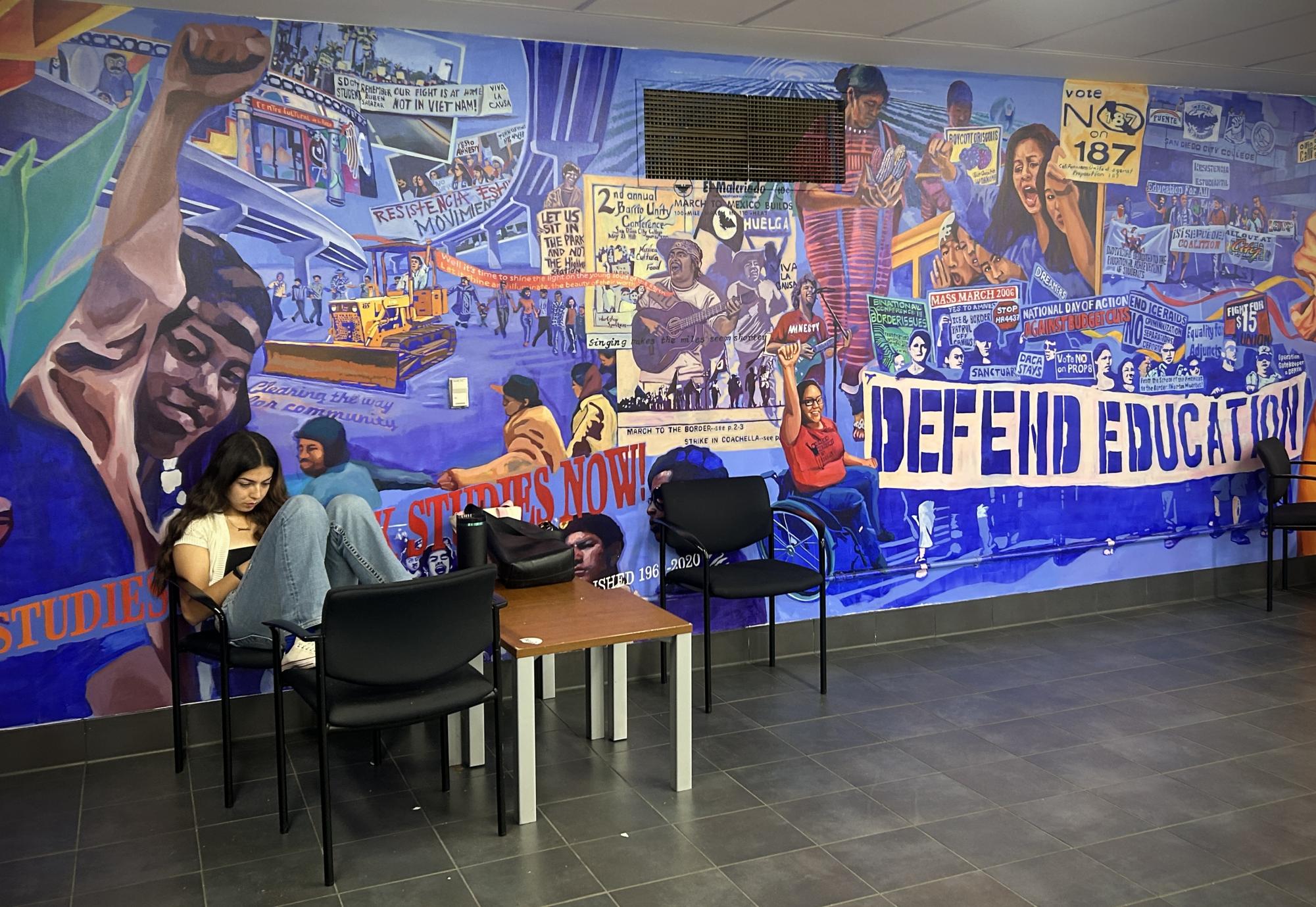
Only hours before its scheduled mesa directiva, or board of directors meeting, the MEChA chapter at San Diego City College heard the news of sexual assault allegations against prominent Latine labor organizer and civil rights activist Cesar Chavez.
A day later, in an interview with City Times, Rosa Padilla, who is the internal representative of MEChA at City, said the allegations against Chavez came as no surprise to her.
The current chapter at City never celebrated Chavez because of his anti-immigrant rhetoric, she said, seeing the news as a call to action.
“Moving forward, I guess we’re going to keep doing what we’re doing,” Padilla said, “but become even stronger in our sentiment that we ought to protect those who might feel like their voices aren’t important enough.”
Chavez, who died in 1993 at the age of 66, has been accused of sexually abusing young girls and women dating back to the 1960s, first reported by the New York Times on March 18.
Among the women who accused Chavez is Dolores Huerta, co-founder of the United Farm Workers and the prominent organizer alongside Chavez.
Huerta, 95, remained silent about the assault that happened when she was 36 because she was a woman fighting for respect in the male-dominated space of union organizing.
She was fearful her account would affect the progress of the organized labor movement, according to the New York Times.
In addition to Huerta’s account, the allegations added that Chavez was grooming and sexually abusing girls who were involved in the movement for years.
Reaction locally, statewide and across the nation has been swift.
California legislators, as well as officials in cities like Los Angeles, announced on March 19 that the state was renaming “Cesar Chavez Day,” celebrated annually on March 31, to “Farmworkers Day.”
Cities like San Antonio and Lansing, Mich. cancelled events scheduled to align with the observance a day after the investigation was published.
One event, held in Arizona’s Cococinco County, opted to reschedule and change its name to move the focus from Chavez himself to the farmworkers the movement works to support decades after it began.
According to Ricardo Martinez, the chairman of MEChA, the focus of the group at City had already been trained on making sure it was a safe and inclusive space where students can feel comfortable with one another.
Movimiento Estudiantil Chicano de Aztlán, also known as MEChA, is a student organization that promotes higher education, Latine culture and unity while working towards social justice, according to the Philosophy of Movimiento Estudiantil Chicano De Aztlán.
The group has a history across colleges and universities nationwide, dating back to its founding in 1969 at a conference in Santa Barbara, California.
Students from campuses from all over California adopted a manifesto that called for the unification of all student organizations into one known as MEChA, according to the Civil Rights and Labor History Consortium at the University of Washington.
“We shouldn’t really idolize anyone in that way more so than the movement as a whole,” Martinez said. “There’s just a natural evolution away from idolizing these type of figures and respecting the women and all others that were undermined in that movement.”
Added Padilla: “It’s a great opportunity for us to go back and revise our history.”
In the March 19 interview, Padilla said that regardless of the political climate, there should always be space for women and victims to feel comfortable to speak out.
“Dolores Huerta herself said that she didn’t feel comfortable because she thought it would taint the movimiento,” Padilla said. “And that shouldn’t be the case ever.”
Following the news of these allegations, San Diego Community College District Chancellor Greg Smith sent out an email on March 18 to faculty and staff expressing support for survivors of Chavez’s alleged abuse.
“I encourage you to take time with complexity of this moment rather than resolve it too quickly,” Smith wrote. “We should not dismiss the allegations to protect a legacy, and we cannot abandon the movement’s vital work.”
In that same email, Smith addressed the name of the College of Continuing Education, Cesar E. Chavez campus.
“It is premature to assume any outcome, and we will engage with many community stakeholders before reaching any conclusion about the future of the naming of the facility,” Smith wrote.

In its March 18 meeting, the MEChA chapter at City discussed either making public comments at the next SDCCD Board of Trustees meeting, scheduled for April 16 at 5 p.m. at the North City Campus, or attempting to make the renaming of the Chavez campus an agenda item.
“Something along those (lines), to reflect the aspect that we acknowledge, we revisited our history, and now we’re improving on what we can do as a district,” Martinez said. “That’s something that we want to visit over with the Board of Trustees, to see if the Cesar Chavez campus can be renamed, and if so, how soon?”
Martinez said he wants to encourage Smith to have Chavez’s name removed from any installations that he may be across the district.
Padilla also suggested professors take a second look at their curriculum and see who they’re putting at the forefront of their teachings.
Former City College professor Abel Martinez said he is doing that right now in the courses he teaches as a lecturer at San Diego State in the Department of Chicano Studies.
“I have a responsibility as a faculty in this department at San Diego State to develop an analysis that I’m going to present to my students, you know?” he said. “My analysis of it is that this is an opportunity to learn. One of the big lessons that we can learn from this is that we need to stop focusing so much on individuals and start thinking more about the broader population.”
Marisol Sandoval contributed to this report.
This story was edited by Tresean Osgood and David J. Bohnet.
Editor’s note: City Times Media has updated its style guide to standardize the use of the word Chicane and/or Latine when referring to people together who identify as a person from, or whose ancestors were from, a Latin American land or culture. The Associated Press Stylebook recommends using the word Chicano/Latino.