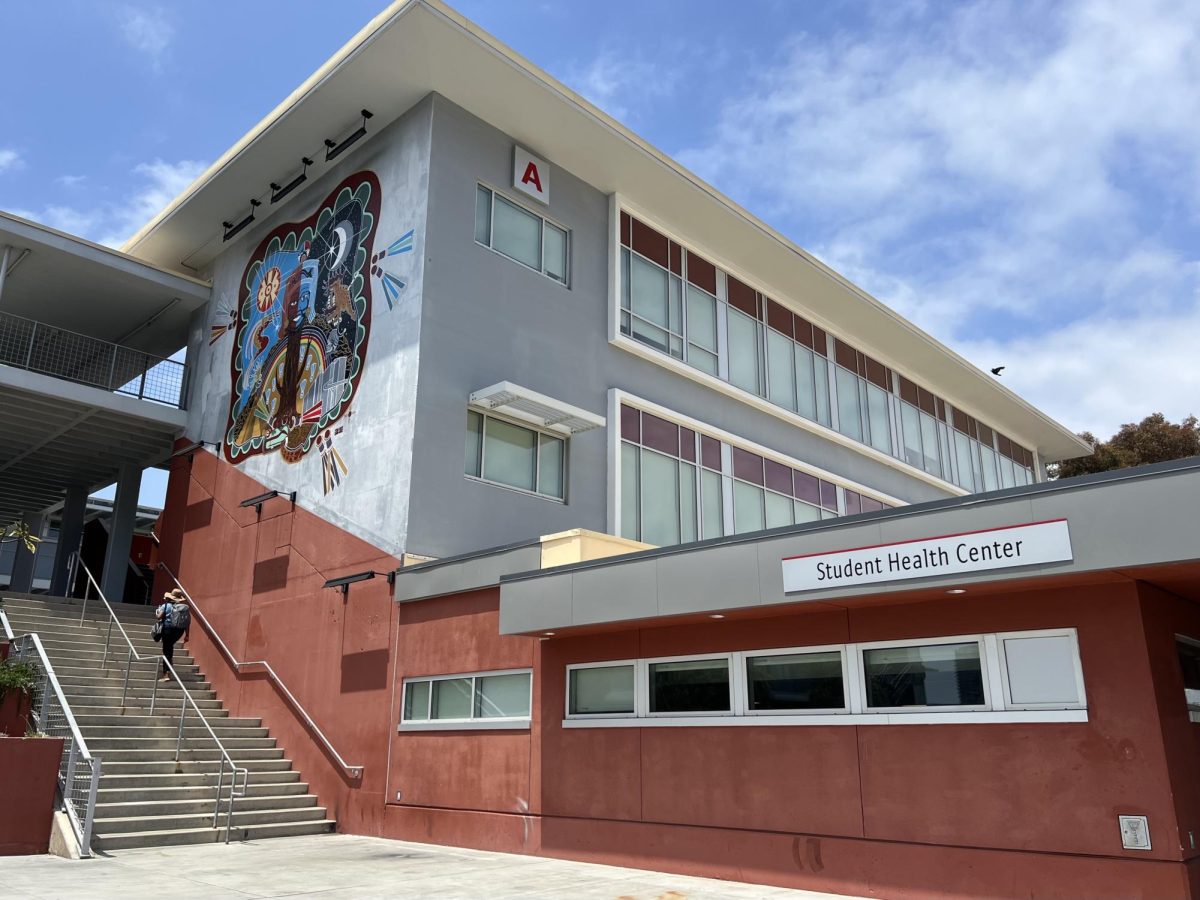
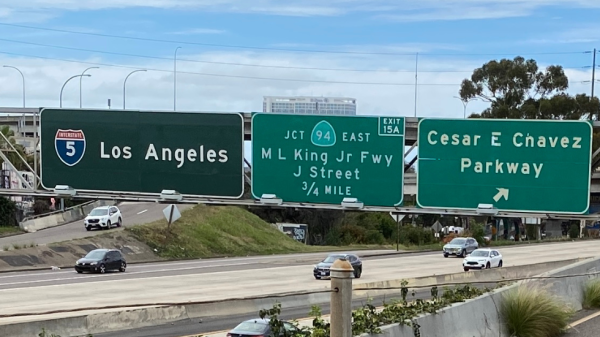
Update, April 6, 4:55 p.m.: SDCCD Board of Trustees unanimously vote to temporarily change CCE’s Cesar Chavez Campus to Harbor View Campus of Continuing Education.
This is a developing story. Stay with City Times Media for more updates.
Para leer este articulo en español, haz clic aquí.
If you or someone you know has been a victim of sexual abuse, text “STRENGTH” to the Crisis Text Line at 741-741 to be connected to a certified crisis counselor.
If you are experiencing domestic violence, call the National Domestic Violence Hotline at 1-800-799-7233, or go to thehotline.org. All calls are toll-free and confidential. The hotline is available 24/7 in more than 170 languages.
San Diego City College student Zavahna Chavarín was riding the San Diego trolley to campus when she first saw posts about sexual abuse allegations against labor organizer Cesar Chavez.
Chavez, who died in 1993 at the age of 66, is accused of sexually abusing young girls and women dating back to the 1960s, according to a New York Times investigation published March 18.
Among those who came forward is Dolores Huerta, co-founder of the United Farm Workers, who worked alongside Chavez.
At City College, the response to the allegations against Chavez shows a shift – younger generations are no longer separating his legacy from the harm, but rethinking who and what their movements choose to honor.
“The Chicano community, we are so tight-knit,” Chavarín said, “especially in the social justice area. People really know each other. So it’s a difficult thing to move past.”
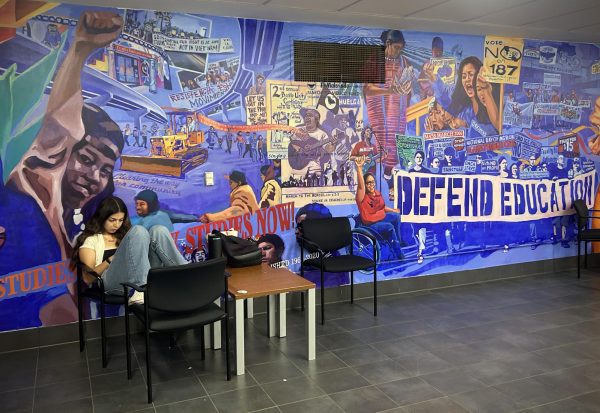
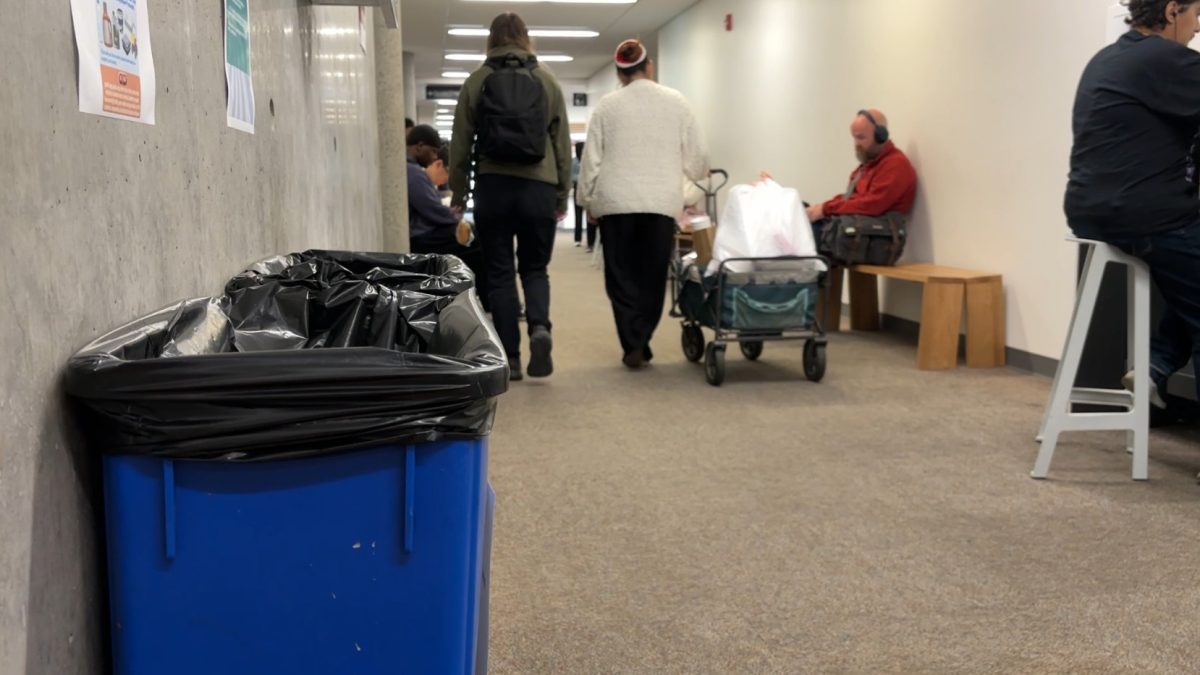
Days later, on the third floor of the Arts and Humanities building at City College, down a hallway lined with student-crafted artwork, Chavarín was among the artists gathered for a Tuesday club meeting.
The meeting, organized by El Artivism y Cultura Klub and intended as an artist workshop, had become a safe space where the City community could collectively process the ongoing ICE raids alongside the Chavez allegations.
The sounds of 90s hip-hop filled the room as students and faculty moved through the space. New attendees found solace and decorated their name tags with gel pens, as laughter cut through the tension surrounded by murals honoring lives lost to ICE raids.
“We all have a responsibility to know what’s going on and figure out how to move forward,” Chavarín said.
Aylén Padilla, a radio and podcast major, wants to see institutions remove Chavez’s name and shift recognition to farmworkers who helped shape California’s identity and history.
City College’s MEChA chapter earlier publicly urged the San Diego Community College District to remove any references to Cesar Chavez.
“His name should be removed, but credit should remain with the people who built the movement,” Padilla said, “especially Filipino farmworkers and Latino workers who made it possible.”
The reaction to Chavez is no longer centered on his role in the United Farm Workers, students said, but on how the Latine community confronts harm and uses momentum to speak out.
“Whoever has a chance to make a statement in solidarity,” Chavarín said, “it’s important to show presence and support.”

SDCCD Chancellor Greg Smith addressed the situation in a district-wide email to the SDCCD community the same day the Times released the investigation.
“We should not dismiss the allegations to protect a legacy, and we cannot abandon the movement’s vital work,” Smith wrote.
Smith sent two more emails regarding the allegations against Chavez.
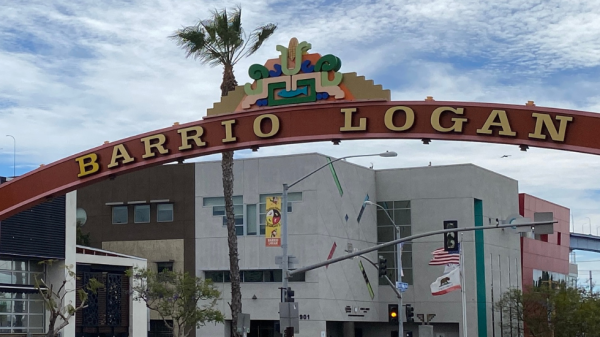
In one, he announced a Board of Trustees meeting at the College of Continuing Education’s Cesar E. Chavez campus to address the issue.
It is scheduled for Monday, April 6, in Room 103 from 4-7 p.m.
Can’t see the video? Click here. Captions available on the stream.
California renamed Cesar Chavez Day to Farmworkers Day last month, shifting toward honoring farmworkers and activists collectively.
At City, faculty are unpacking conversations about accountability and legacy in their classrooms, encouraging students to think beyond individual figures and toward shared histories.
“We can still feel proud of the movimiento and what they built, and feel like that had a great impact on our community, but not necessarily center that individual,” City Chicana/o/e literature professor Norell Martínez said.
While many students interviewed by City Times Media described reactions to the allegations as shock and tension, some faculty said they were not surprised by the news.
“I was not 100% surprised,” Martínez said. “I felt bad for the women and their families.”
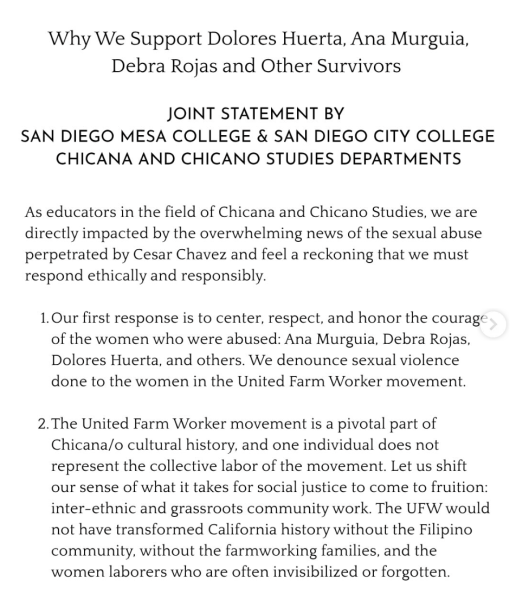
In a joint statement shared on Instagram, City and Mesa colleges’ Chicano studies programs affirmed their support for survivors and emphasized accountability.
“We denounce sexual violence done to the women in the United Farm Worker movement,” the statement read. “We must name our errors, flaws, and confront the continued power relations that uphold patriarchal and machista cultures.”
Danny Acevedo, a psychology major at City, worries about how the community he identifies with will be perceived beyond campus amid a current political climate targeting predominantly Latine immigrants, among others.
“I’m just scared that people are going to view us differently,” Acevedo said.
Both programs also acknowledged the intercultural support from the Filipino community and women’s invisible labor that were often overlooked in the movement.
“UFW would not have transformed California history without (them),” the statement read.
Historians say hierarchical leadership structures can allow abuse to go unchecked.
“The UFW… did operate in a way that created space for abuse to happen,” said Abel Macícas, who teaches U.S. history in the Chicana/o/e Studies program at San Diego State University.
Martínez highlighted that collective labor has often been the backbone that historically sustains movements, noting that cultural dynamics can complicate how communities process harm.
“There is a lot of patriarchy and machismo embedded in our culture,” Martínez said.
Still, both Martínez and Macías pointed to a shift in how quickly communities respond to this controversy, compared to past generations.
They both credit rising generations.
“We’re not just going to continue worshipping,” Martínez said.
As conversations continue, students like Chavarín say the moment is not just about justice, but an opportunity to do what is right for Huerta and survivors.
“We’re a community. We need to encourage each other to be educated on what’s going on, and inform people who maybe don’t know,” Chavarín said. “There’s also this ‘man versus woman’ tension, but we need to draw the focus back on what needs to happen and justice for Dolores.”
Editor’s note: City Times Media has updated its style guide to standardize the use of the word Chicane and/or Latine when referring to people together who identify as a person from, or whose ancestors were from, a Latin American land or culture. The Associated Press Stylebook recommends using the word Chicano/Latino.
Update, April 7, Story updated to include link to Spanish version and investigation by New York Times.
Update, April 6: Story updated to include embed of special SDCCD Board of Trustees meeting video and direct link, as well as additional photos, links. An import error also resulted in a quote being deleted, which was later replaced.
This story was edited by David J. Bohnet and Tresean Osgood.